Engagement Campaign
Many developments are currently taking place in the EU regarding corporate social responsibility (CSR), including the Corporate Sustainability Due Diligence Directive (CSDDD), the Corporate Sustainability Reporting Directive (CSRD), the Right to Repair Directive, and the Empowering Consumers Directive (EmpCo). These legislative changes are relevant and closely connected to climate justice in a practical way. However, CSR can often seem like a vague or distant topic in the everyday lives of citizens. Younger generations, in particular, are often unfamiliar with the concept, its importance, and its wider implications.
Together with the Allianssi Youth Exchanges team and a group of sustainability-focused volunteers, “the Climate Buddies”, an idea for campaigning for CSR emerged. Combining the observation about the gap between regulations and youth and the period when the CSDDD was being prepared for national implementation in Finland, the topic felt like a natural and timely choice. Additionally, in our view, the proposed national bill contained certain shortcomings that had the potential to undermine human rights and sustainable business practices, reinforcing the willingness to campaign for fair and comprehensive CSR practices. The key message of the campaign was: “Companies must be held accountable for their actions, because it is not acceptable to pursue profit at the expense of other living beings.”
As a part of the EYA European Youth in Action project the main target group of the campaign was youth from 15 to 35 years of age. The goal was to help build a general understanding of what corporate social responsibility means and how it impacts the environment and human rights nationally and globally. The campaign also aimed to encourage youth to participate in climate action and let their voices be heard regarding the national bill.
.jpeg)
The campaign happened through three dimensions: a panel discussion, a social media campaign, and on-site campaigning on Allianssi Youth Exchanges stands during two events. The campaign was centered around the national bill and its weaknesses brought up by Finnwatch, a Finnish NGO investigating the global impacts of business enterprises, who also took part in the preparation process of the bill.
The panel discussion brought together five experts in climate policy, corporate social responsibility, and sustainability. The discussion covered the importance of regulations, the impact of the new bill, and practical ways for young people to participate in climate action. Participants also had the opportunity to write their thoughts, ideas, and proposals on postcards, which were then summarised and forwarded to policymakers.
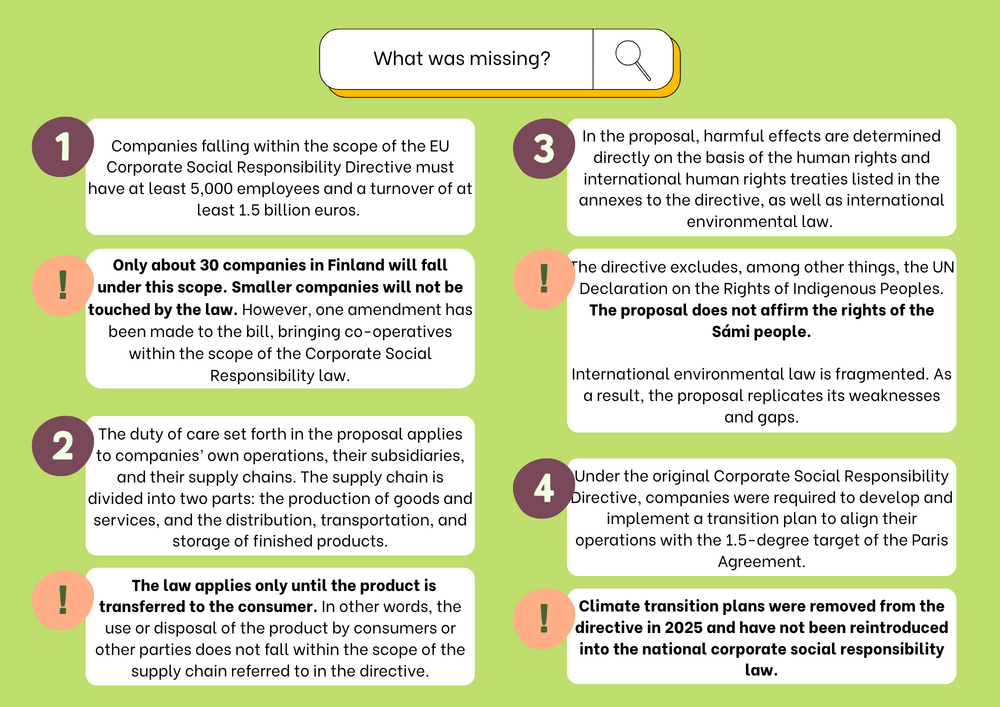
The social media campaign consisted of five posts, both photos and videos, all related to the CSDDD and its national implementation. It took place on the Instagram and Facebook pages of Allianssi Youth Exchanges. It included an introduction to CSR, three shortcomings of the bill, and tools for youth participation.
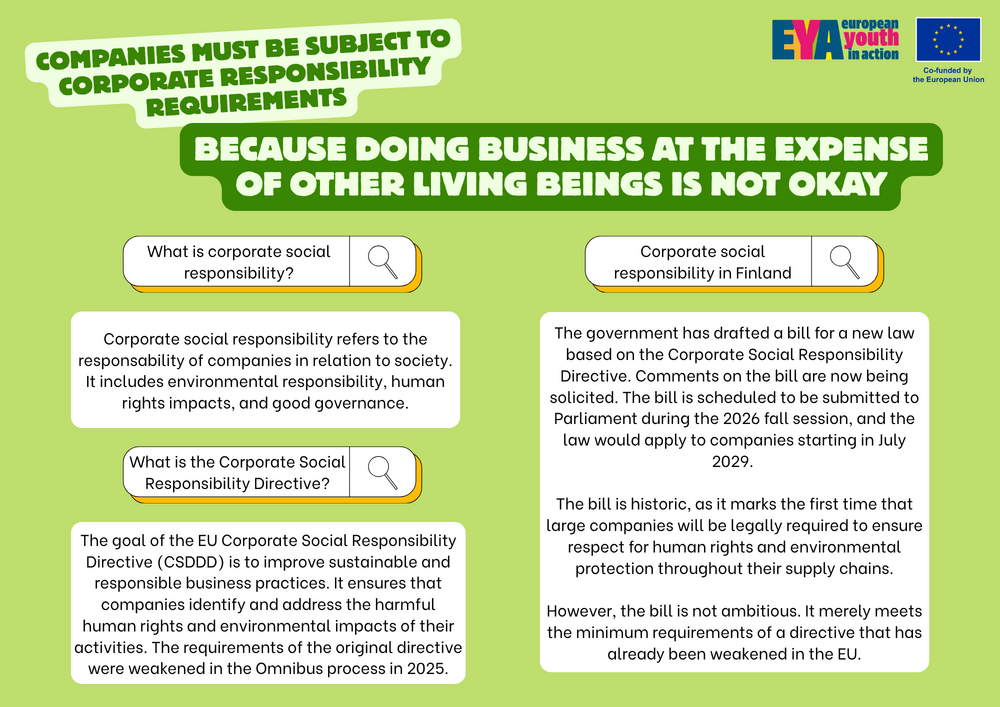
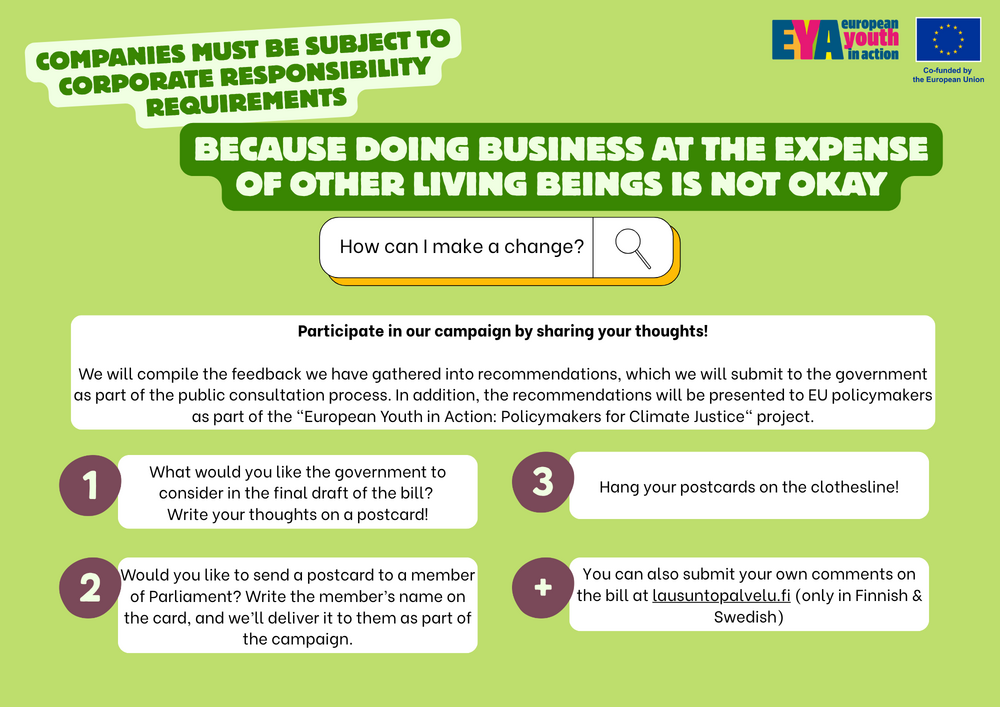
On-site campaigning consisted of presenting information sheets (see below) about corporate social responsibility and its importance. People passing by were encouraged to learn more about the topic, engage in a conversation, and write their thoughts, ideas, and proposals on postcards.
Outcomes
A total of 85 young people participated in the in-person campaign events. A much larger number of people were reached through social media, with an average of 823 views per post on Instagram.
While going through the postcards participants wrote during the campaign, certain categories of concerns emerged. They are detailed below, including the youth’s thoughts, ideas, and propositions summarised.
Respectful, sustainable, and green policies and business practices
Defending Finland's nature, biodiversity, and country image based on clean nature and respect for the surrounding environment
Not seeking economic growth at the expense of the environment
Supporting climate transition plans at the national level
Fighting against greenwashing
Human rights and fair working conditions
Assuring fair working conditions and equal rights on a global scale
Recognising and reinforcing indigenous peoples rights better
Stricter regulations for ultra fast fashion
Mitigating the harmful impacts of business practices on the people affected (e.g. conflicts, peoples displaced, indigenous lands harmed)
Youth, decision making, and future
Giving youth more voice and opportunities to participate in decision making
Not undermining youth’s rights and wellbeing
Working towards reigniting the hope towards the future for younger generations
Supporting youth’s dreams and goals by concrete tools
Encouraging policymakers
Not undermining and underestimating the societal importance and authentic willingness to help of grassroot organisations
Standing up for what is right and taking real action before it’s too late